Bad Credit Car Loans in Suffolk County, NY: What Nobody Tells You Before You Apply
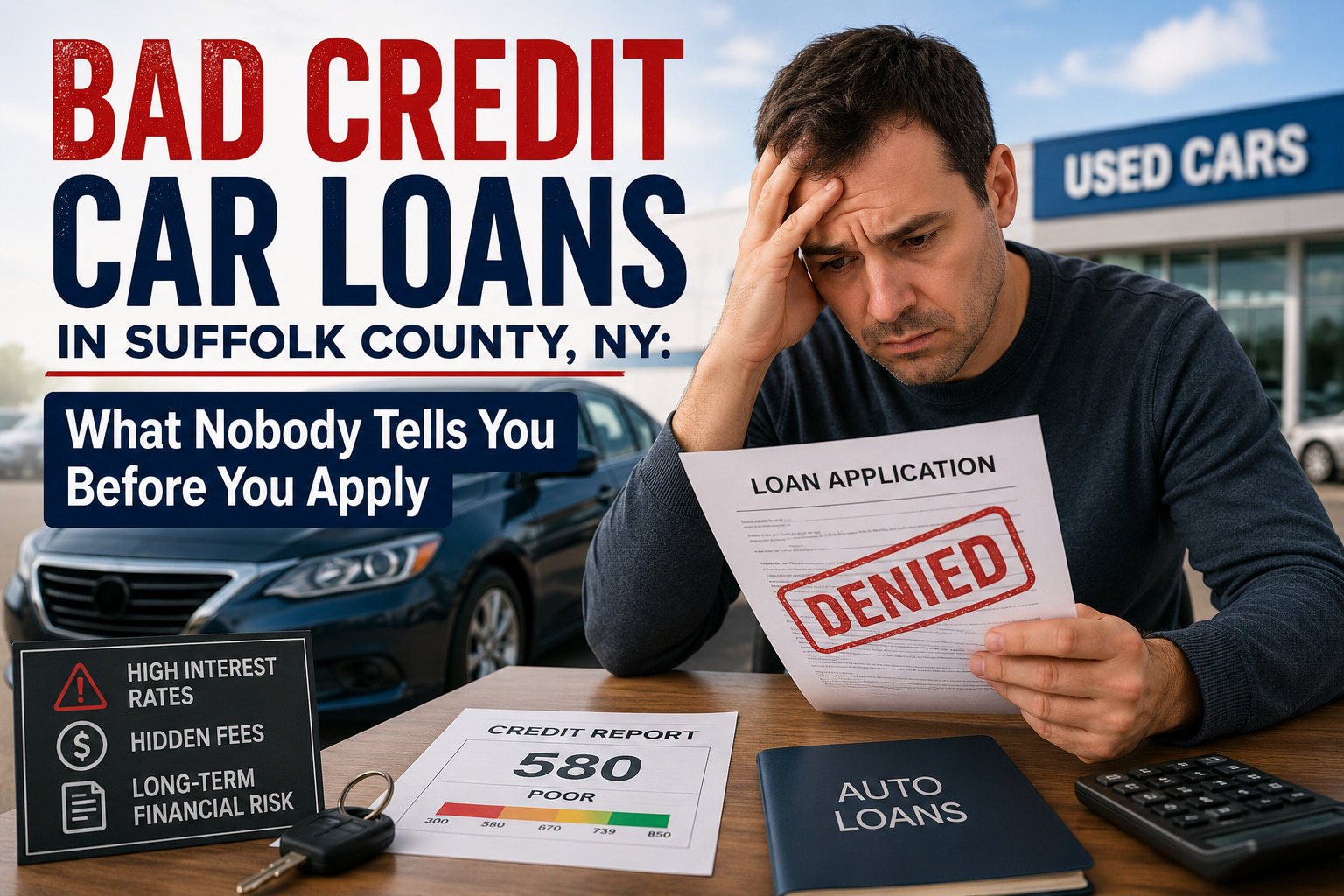
You've been turned down before. Maybe more than once. You walked into a dealership on Jericho Turnpike or Sunrise Highway, sat across from a finance manager, and watched their face change when they pulled your credit. They said they'd "work something out" and then came back with a payment that made no sense — or didn't come back at all. That experience is more common in Suffolk County than most people realize. And it's not because bad credit buyers are irresponsible. It's because the car loan system in New York is genuinely difficult to navigate without knowing how it works — and most dealerships have no incentive to explain it to you. This is the guide that does. We're going to walk through what bad credit actually means for a car loan in Suffolk County, what lenders are actually looking at, what a realistic deal looks like in 2026, what your rights are under federal law, and how to avoid the traps that cost buyers thousands of dollars every single year. No glossy promises. No "guaranteed approval" language. Just the real picture.
What "Bad Credit" Actually Means for a Car Loan in 2026
The word "bad credit" gets thrown around loosely. Lenders and dealerships use it to describe anyone who doesn't fit their easiest approval box. But the actual definitions matter because they determine what you'll pay.
Here's how the credit tiers break down for auto lending, according to Experian's Q4 2025 State of the Automotive Finance Market report:
- Super prime: 781–850 — average used car rate: around 5–6%
- Prime: 661–780 — average used car rate: around 7–9%
- Near prime / nonprime: 601–660 — average used car rate: around 11–13%
- Subprime: 501–600 — average used car rate: around 15–17%
- Deep subprime: 300–500 — average used car rate: 16%+ and higher, or flat denial
If your score is below 620, most traditional banks and credit unions in Suffolk County — including Island Federal and Suffolk Credit Union — will either decline you outright or offer terms that are significantly worse than their advertised rates. Their advertised rates are for members with excellent credit. That's not deception. That's just how tiered lending works.
The gap between what a prime borrower pays and what a subprime borrower pays on the same $15,000 used car over 60 months can be more than $4,000 in total interest. That's a real number that affects real families trying to get to work every day in Huntington, Babylon, Brentwood, and Islip.
The Real Situation in Suffolk County Right Now
Suffolk County runs on cars. There is no meaningful public transit alternative for most of the county. If you live in Patchogue and work in Hauppauge, or you're in Bay Shore and your job is in Riverhead, a car is not optional. It is how your family functions.
That's why bad credit car buying pressure is particularly intense here. The demand is real. The need is urgent. And because dealers know this, the leverage in the transaction often sits with them — not with you.
Here's what the broader data tells us about where the market is right now:
According to the Federal Reserve Bank of New York, 5.2% of outstanding auto debt was at least 90 days late in Q4 2025, up 7.7% from Q4 2024. That's a broad trend across all credit tiers, not just subprime. Even buyers with decent credit are feeling the squeeze from higher prices and elevated monthly payments.
For subprime borrowers specifically, the numbers are more alarming. 6.65% of subprime borrowers were at least 60 days late on their car payments — the highest delinquency rate since the 1990s, according to Fitch Ratings.
What's driving this? A few things hitting at the same time:
Rising auto insurance premiums are contributing to higher car ownership costs, with the average annual premium reaching $2,638 in 2025 — over a 12% increase from last year. That's before your loan payment. That's before gas. Before maintenance.
The average used car loan in the US hit $27,528 in Q4 2025 according to Experian. For a subprime borrower at 15% interest on a 60-month term, that's a monthly payment well above $600 on a car that may be worth considerably less by the time it's paid off.
None of this is meant to scare you away from buying a car. A car is essential in Suffolk County. The point is to walk in knowing what the real numbers look like so you aren't surprised.
What Lenders in Suffolk County Are Actually Looking At
When a lender evaluates a subprime car loan application, they're not just looking at your credit score. That number is a starting point, not the full story. Experienced finance managers — and the lenders behind them — evaluate several factors together.
Monthly income and stability. Lenders want to see that your monthly income is at least 2.5 to 3 times your projected monthly payment. If you're looking at a $450/month payment, they want to see $1,100–1,350 in verifiable monthly income minimum. SSI, disability income, and W-2 employment all count. Self-employment income also counts but requires more documentation — bank statements, tax returns, or a letter from an accountant.
Time at current employment or income source. Most subprime lenders want to see six months or more at your current job or with your current income source. If you just started a new job last month, it's not disqualifying, but it does complicate the application.
Down payment. This matters more than most buyers realize. A larger down payment reduces the lender's risk and often opens doors that were closed at zero down. Even $500–1,000 down on a lower-priced vehicle can shift an approval. "No money down" is possible in some situations, but it typically means a higher rate, a longer term, or a stricter vehicle requirement.
The vehicle itself. Lenders care about what you're buying, not just who you are. Most subprime lenders in the Suffolk County area will not approve loans on vehicles over 10 years old or with more than 120,000 miles. The vehicle is their collateral. If you default, they need to be able to recover something. A 2010 Chevy with 150,000 miles is harder to lend against than a 2018 Honda with 70,000 miles.
Debt-to-income ratio. If you're already carrying significant debt — credit cards, student loans, a previous car loan — lenders calculate your total monthly obligations against your income. High existing debt can limit your approval even if your income looks solid.
Trade-in or existing vehicle. If you have a car to trade in, even with negative equity, it affects the transaction structure. Some dealers and lenders will roll negative equity into a new loan, which is a practice that deserves scrutiny (more on that below).
The Soft Pull vs. Hard Pull Question — And Why It Matters
One of the biggest fears that holds back bad credit buyers in Suffolk County is this: "If I apply and get turned down, will it hurt my score even more?"
It's a legitimate concern. The answer depends on where you apply and how you apply.
A hard pull — also called a hard inquiry — is what happens when a lender formally pulls your credit as part of a loan decision. It shows up on your credit report and can lower your score by a few points. Multiple hard pulls in a short window can add up.
A soft pull — sometimes called a soft inquiry or pre-qualification — is a preliminary check that does not affect your credit score. Many online matching services and pre-qualification tools use soft pulls.
When you submit a match request through a service like ours, we use your self-reported credit situation — not a formal credit pull — to connect you with dealers who work with your profile. The formal credit application happens later, at the dealership, when you've already established that they can work with you. That's a fundamentally different experience than walking cold into a dealership and letting them run your credit with no idea where you stand.
If you're applying at multiple dealerships directly, try to do it within a 14-day window. Credit scoring models from FICO and VantageScore both treat multiple auto loan inquiries within a short period as a single inquiry for scoring purposes. Shopping around doesn't have to cost you points — if you do it efficiently.
What Actually Happens Inside a Dealership — The Behind the Scenes Reality
This section is about what most buyers never see.
When you sit down with a finance manager at a Suffolk County dealership, you're not just talking to one lender. That finance manager is working with a network of lenders — captive finance arms of manufacturers, regional banks, credit unions, and specialized subprime lenders. They submit your application to multiple lenders simultaneously and receive offers back.
Here's the part most buyers don't know: dealerships are compensated by lenders based on the interest rate they book. A lender might approve you at 14%. The dealership marks that up to 17% and keeps the difference. This is called "dealer reserve" or "dealer markup," and it is legal in New York. The CFPB has examined this practice extensively and found it can result in buyers paying substantially more than necessary.
According to the CFPB's Special Edition Supervisory Highlights on Auto Finance published in October 2024, examiners found that subprime auto loan originators engaged in deceptive acts or practices, including luring consumers in through deceptive advertising about available loan terms and failing to provide accurate and complete disclosures.
This isn't an accusation against every dealership in Suffolk County. Most are legitimate businesses. But understanding that dealer markup exists — and that you can ask for the "buy rate" (the rate the lender actually approved you at) — is a tool most buyers don't know they have.
What you can do about it:
- Ask the finance manager directly: "What rate did the lender approve me at?" They may not answer, but asking signals that you're informed.
- Get pre-qualified through an independent source before walking in. When you already know you can get approved somewhere, the dealership's leverage shifts.
- Compare total cost, not just monthly payment. A lower monthly payment stretched over 84 months costs significantly more than a higher payment over 48 months.
The Negative Equity Trap — A Real Suffolk County Scenario
Here's a situation that plays out regularly at dealerships across Long Island.
A buyer in Brentwood has a 2016 Hyundai with 95,000 miles. They owe $8,200 on it. The car's trade-in value is $5,500. That's $2,700 in negative equity — they owe more than the car is worth.
The dealership offers to "roll over" that negative equity into the new loan. So instead of starting fresh, the buyer now owes $2,700 on a car they no longer own, wrapped into a loan on a car they just bought. This is sometimes presented as a convenience. What it actually does is put you underwater from day one on your new vehicle.
According to industry data cited by Snell & Wilmer, 28% of trade-ins are underwater, averaging $6,905 more owed than the vehicle's value. Nearly one in three people trading in a car in America right now is in negative equity. And rolling it into a new loan compounds the problem.
This doesn't mean you should never trade in an underwater vehicle. Sometimes the math still works if you're moving into a significantly better car on better terms. But go in knowing the number. Get your payoff balance from your current lender before you walk into the dealership.
Income Types That Qualify — Don't Let Anyone Tell You Otherwise
One of the most damaging myths in the Suffolk County car buying market is that only W-2 employees with traditional paychecks can get financed. This is simply not true.
Suffolk County has a diverse working population. Many residents work in trades, hospitality, home care, cleaning services, and other industries where cash income, 1099 income, or variable hours are normal. Here are income sources that participating lenders in our network accept:
- W-2 employment — standard paycheck, easy to document
- Self-employment / 1099 — requires bank statements showing consistent deposits, typically 3–6 months
- SSI (Supplemental Security Income) — counts in full, requires award letter
- SSDI (Social Security Disability Insurance) — counts in full, requires award letter
- Retirement income / Social Security — counts, requires benefit statement
- Child support / alimony — counts if documented and consistent
- Multiple part-time jobs — income can often be combined with documentation
The key is documentation. Whatever your income source, you need to be able to show it consistently. Bank statements are often more convincing than pay stubs for lenders evaluating irregular income.
What "Participating Lenders" Actually Means — Our Legal Disclosure
We want to be completely clear about how we work, because transparency is exactly what this industry often lacks.
Suffolkcounty.autos is a lead matching service. We are not a lender. We are not a dealership. We do not originate loans, approve applications, or set interest rates.
When you submit a match request through our platform, we share your information with participating Suffolk County dealerships and their lending partners who may be able to work with your credit situation. Submitting a form does not guarantee approval. It does not constitute a credit application. It is a request to be connected with someone who can evaluate your situation honestly.
Approval decisions are made entirely by the lender or dealership you're connected with, based on their own criteria. We have no influence over those decisions.
This structure exists for a reason. The moment we started making loan guarantees, we would be subject to lending regulations that require licensing and capital requirements we don't have. More importantly, guaranteed approval claims in auto lending are almost universally deceptive. The CFPB found that subprime loan originators engaged in deceptive acts or practices when service providers mailed prescreened advertisements marketing rates "as low as" specified APR rates to consumers who in fact had no reasonable chance of qualifying for or being offered rates at or near that level.
We don't make those claims. We connect you with real options.
For a thorough understanding of your rights as a car loan borrower in New York, the Consumer Financial Protection Bureau maintains a comprehensive resource center at cfpb.gov/consumer-tools/auto-loans. It covers your right to accurate disclosures, your rights if a vehicle is repossessed, and how to file a complaint if you believe a lender has treated you unfairly.
The Realistic Deal: What to Expect in Suffolk County in 2026
Let's put some real numbers on the table.
If you have a credit score in the 500s, are employed with verifiable income, have been at your job for six months or more, and can put $1,000–1,500 down on a vehicle priced between $9,000 and $14,000, here's roughly what you're looking at in the current Suffolk County market:
- Interest rate: 15–21% depending on the lender, your profile, and the vehicle
- Loan term: 48–72 months
- Monthly payment on a $12,000 vehicle at 18%, 60 months: approximately $305–325
- Total interest paid over life of loan: approximately $6,300–7,200
That's a real cost. It's higher than what prime borrowers pay. That's the honest truth. But it's also not impossible, and for many buyers in Suffolk County, it's the difference between getting to work and not getting to work.
The goal, once you're in the car and making payments consistently, is to refinance. After 12–18 months of on-time payments, many subprime borrowers see meaningful score improvement that can qualify them for better rates. That refinance can save thousands over the remaining loan term.
Five Things to Do Before You Apply
1. Pull your own credit report for free. You're entitled to free weekly credit reports from all three bureaus at AnnualCreditReport.com. Look for errors. Incorrect late payments, accounts that aren't yours, and outdated derogatory marks are all grounds for dispute — and fixing them can move your score meaningfully before you apply.
2. Get your payoff balance if you have an existing car loan. Call your current lender and ask for your 10-day payoff amount. Know whether you're in positive or negative equity before you walk into any dealership.
3. Document your income now, before you need it. Gather two to three months of bank statements. If you have pay stubs, gather three to four weeks' worth. If you receive SSI or SSDI, have your current benefit award letter ready. Being prepared cuts days off the process.
4. Research the vehicle before the financing. The car you're approved for depends partly on the car itself. Lenders prefer vehicles that are newer and have lower mileage. A well-chosen vehicle at $10,000 will often get better financing terms than a $15,000 vehicle with 130,000 miles.
5. Know your number. Decide in advance what monthly payment you can genuinely afford. Not what the dealership tells you is affordable. What you know from your own budget. That number anchors the conversation and keeps you from agreeing to something that stretches you into delinquency six months later.
A Note on What's Changing in 2026
The regulatory environment around subprime auto lending is shifting. The CFPB is considering limiting its supervision of auto finance companies to those that originate more than 1 million loans a year — up from the current threshold of 10,000 — which could reduce federal oversight of many subprime lenders. If that rule takes effect, the protections that currently constrain some of the more aggressive practices in subprime lending could weaken.
This makes consumer education more important, not less. When federal oversight pulls back, the burden shifts to informed buyers. Knowing how dealer markup works, understanding your right to accurate disclosures, and working with local services that have no incentive to oversell you on a bad deal — these things matter more when the regulatory safety net is thinner.
We're watching this. And we'll keep writing about it.
The Bottom Line
Bad credit car loans in Suffolk County are real, available, and manageable — if you go in with accurate expectations. The process is harder than it should be. The rates are higher than they should be. And too many buyers in Brentwood, Central Islip, Bay Shore, and Patchogue have walked out of dealerships feeling like they had no choice when they actually did.
You have choices. Not unlimited choices — credit does matter. But more choices than the dealership in front of you will typically acknowledge.
The first step is knowing what your situation actually looks like. The second step is connecting with dealers in Suffolk County who work honestly with buyers in your position — not dealers who see bad credit as a reason to extract maximum profit.
That's what we do. No guarantees. No fake promises. Just a real match with a real dealer who can actually help.
Suffolkcounty.autos is an independent local lead-matching service. We are not a lender, a dealership, or a financial institution. Submitting a match request does not guarantee financing approval or vehicle availability. For independent guidance on your rights as a car loan borrower, visit the Consumer Financial Protection Bureau at cfpb.gov/consumer-tools/auto-loans.
Frequently Asked Questions — Bad Credit Car Loans in Suffolk County
Can I get a car loan with bad credit in Suffolk County NY?
Yes. Several dealerships in Suffolk County work with subprime lenders who specialize in bad credit car loans. Approval depends on your income, employment stability, down payment, and the vehicle you choose — not just your credit score. Scores below 620 are considered subprime but do not automatically disqualify you.
What credit score do I need to get a car loan in Suffolk County?
There is no universal minimum credit score for a car loan in Suffolk County. Subprime lenders work with scores in the 500s and sometimes lower. The lower your score, the higher your interest rate will be. Deep subprime borrowers with scores between 300 and 500 may face limited options or require a larger down payment.
Will applying for a car loan hurt my credit score?
A formal credit application triggers a hard inquiry which can lower your score by a few points. However, if you apply at multiple dealerships within a 14-day window, credit scoring models treat those as a single inquiry. Pre-qualification tools that use a soft pull do not affect your credit score at all.
What income types qualify for a bad credit car loan?
Most subprime lenders in Suffolk County accept W-2 employment, self-employment with bank statements, SSI, SSDI, Social Security retirement income, child support, alimony, and multiple part-time jobs combined. Your income must be verifiable and consistent — typically at least 2.5 to 3 times your projected monthly payment.
How much down payment do I need for a bad credit car loan?
There is no fixed minimum, but a down payment of $500 to $1,500 significantly improves your approval chances and can lower your interest rate. No money down loans are possible in some situations but typically come with higher rates and stricter vehicle requirements.
Is Suffolkcounty.autos a lender or a dealership?
No. Suffolkcounty.autos is an independent local lead-matching service. We connect car buyers in Suffolk County with participating local dealerships and their lending partners. We are not a lender, we do not originate loans, and submitting a match request does not guarantee financing approval. All credit decisions are made by the dealership or lender you are matched with.
What interest rate should I expect on a bad credit car loan in Suffolk County?
According to Experian's Q4 2025 data, average interest rates for subprime borrowers with scores between 501 and 600 on used car loans are approximately 15 to 17 percent. Deep subprime borrowers may see rates above 20 percent. The exact rate depends on your credit profile, income, down payment, and the specific lender.
Can I get a car loan with a repossession on my record in New York?
A prior repossession makes approval harder but not impossible. Some specialized subprime lenders in Suffolk County work with buyers who have repossessions on their record, particularly if the repossession is older than two years, you have stable income, and you can provide a reasonable down payment. Each lender evaluates repossessions differently.
Ready to get matched?
A local Suffolk County agent will reach out within hours — no spam, no hard pull.
Get Matched Now →More guides for Suffolk County buyers
Local guides written for Suffolk County car buyers — bad credit, financing, and cash purchase advice. We cover the real landscape of used car buying on Long Island so you can walk into any dealer informed.